

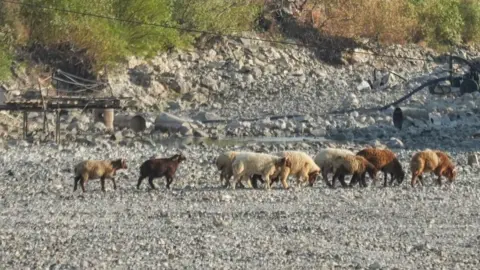
Outside a rural area by the city of Hama, crop lands ought to be lush and productive with crops.
Instead, a local farmer's land lies barren, producing only a third of its normal output.
"Recently proved devastating due to the water crisis," explained the middle-aged farmer.
His land yielded merely 190kg per unit—far below the expected quantity seen in a normal year.
"{We haven't recovered what we put in; we've suffered financially. It's impossible to afford next season's planting," he emphasized.
With a pair of teenage children to provide for, he is relying on funds from family to get by.
Widespread Situation
The plight is echoed across the nation, where the gravest rain shortage in many years has cut wheat harvests by a significant portion.
An anticipated wheat shortfall of over two and a half million tonnes is predicted this year—representing the yearly nutrition of millions of Syrians.

Growing Food Insecurity
Without more food aid or the means to bring in supplies, the crisis may deteriorate severely.
Over 14 million Syrians—around 60% the population—already struggle to meet their nutritional needs.
Of these, 9.1 million experience serious hunger, with 1.3 million in extreme situations.
Precipitation has fallen by about seventy percent, crippling three-quarters of dependent agricultural land.
"This is the line between people staying in their communities or being forced to migrate," stated an representative.
Household Struggles
Farming communities are offloading herds to compensate for reduced revenue, cutting back their food intake.
Malnutrition rates among minors and women are rising.
Grain is a essential commodity in Syria, used for bread and traditional dishes—affordable foods that are now rising in value.
In the case of Sanaa Mahamid who is thirty-nine, affording food has become increasingly hard.
With several dependents, she depends on her older sons' wages, which fall short of basic costs.
"At times we resort to money only to purchase food," she shared.
Last year, a bag of flatbread was priced at five hundred Syrian pounds, but today it is four thousand five hundred.
For her household, she needs two portions a daily—an expense of 9,000 pounds, not including other food.
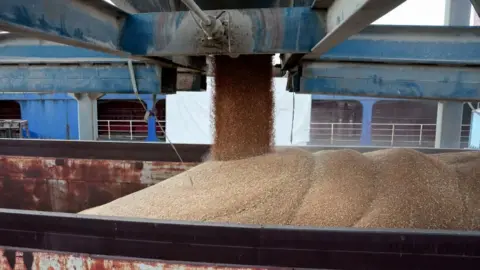
Official and International Response
The emergency poses a significant challenge for the administration, which is striving to rebuild the economy after a long period of war.
Aid agencies are offering financial help for those most vulnerable, but officials caution that these are short-term fixes.
"The goal is to help farmers in the agricultural industry," said a representative.
Financial support have been distributed to small farmers who experienced the whole crops.
But, after a long time of war, Syria's agrarian system was already damaged by economic collapse, broken water systems, and unsafe land.
Water Problem
In critical agricultural areas, wheat land must have numerous irrigation cycles per growing period, but as a result of shortage of rainfall, most cultivators find it impossible to keep up.
"The farmer's main challenge is obtaining irrigation," explained a area official.
Water requires fuel, and fuel prices have increased dramatically, costing 11,000 to twelve thousand currency per litre.
Expensive fuel prices and frequent interruptions have rendered equipment out of reach for most farmers.
Long-Term Solutions
A focus for the authorities is funding water projects—such as eco-friendly watering systems—to provide resources more accessible.
But those initiatives require long-term investment and resources—advantages that wheat farmers cannot access currently.
Therefore, for countless Syrians across the nation, there is just one hope to do in the next period: pray for rain.


